Learning environments designed for everyone. And for each individual.
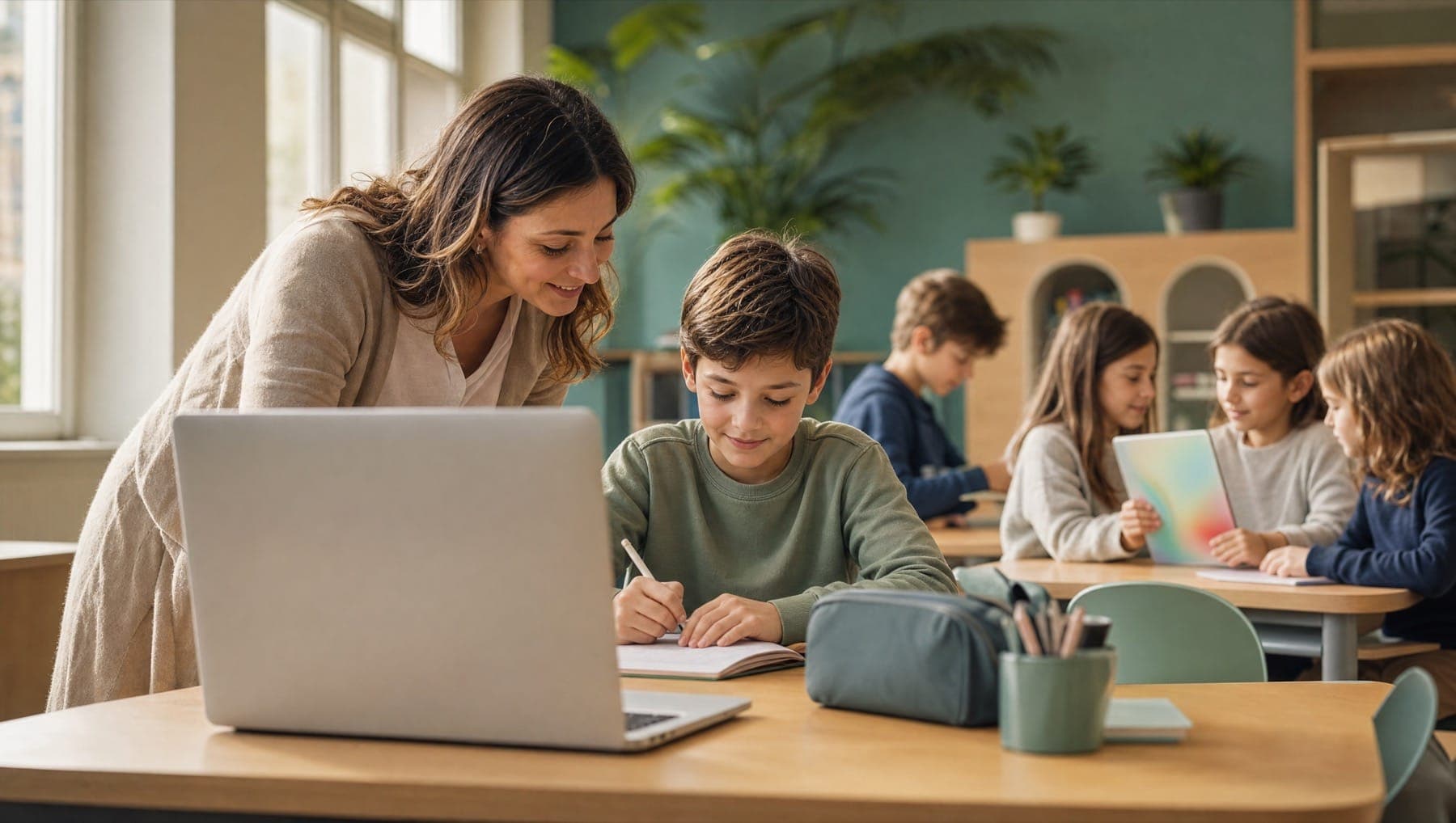
Dedicated technologies, configurations, and training to make learning more accessible, customizable, and closer to the real needs of students and teachers.
Inclusion is the way a school should be designed. Every classroom is made up of different students: some struggle to read, some need writing aids, some learn better through images and videos, some need clear routines, some are learning Italian, some have difficulties with attention, language, or communication, and some simply need to encounter the same content through different paths.
That is why Kyron does not treat accessibility as an option to be activated only when a specific need arises. We consider it a quality of the learning environment: something that must be present from the very start, in the choice of devices, platforms, furniture, apps, settings, and training programs.
A solution is truly inclusive when it does not isolate the student, does not expose them, and does not force them to visibly use "different" tools. It is inclusive when it makes it easier for everyone to read, write, communicate, find their bearings, participate, and learn.
Built-in accessibility, in every tool
The technologies we offer are also evaluated for their ability to adapt to different needs.
Text-to-speech, dictation, voice synthesis, translation, text customization, magnification, high contrast, switch control, subtitles, tools for organizing activities, simplified environments, and communication-support features are not minor details: they are what allows a student to access content, take part in the lesson, and work alongside others.
That is why, when we build a project, we analyze the entire environment: personal devices, interactive displays, software, cloud platforms, classroom management tools, dedicated apps, furniture, and everyday usage. The goal is not to add technology to teaching, but to reduce the obstacles that prevent each person from learning in their own way.
The same content, different ways to encounter it
Inclusion begins when a school stops asking all students to learn in the same way.
For some, the problem is reading a text that is too dense. For others, it is writing by hand, using the keyboard, or organizing their thoughts. For others still, it is understanding instructions in Italian, sustaining attention, finding their bearings throughout the day, communicating a need, or taking part in a shared activity.
Inclusive solutions exist precisely for this: to offer multiple channels of access to the same content. Text, voice, images, video, maps, translation, handwriting, dictation, recordings, visual routines, guided activities, and assistive tools can coexist within the same learning environment, without turning inclusion into a parallel path.
When the same content can be read, listened to, seen, manipulated, translated, annotated, and reworked, the classroom becomes more accessible for everyone.
Inclusive technology works only if teachers know how to use it
An accessible tool, on its own, is not enough.
For a text-to-speech feature, a visual routine, an augmentative communication app, a management platform, or an assistive device to have real impact, they must become part of teachers' everyday practice.
That is why Kyron pairs its technological solutions with dedicated training programs. We work with teachers, inclusion coordinators, digital teams, educators, and school staff to show not only "how a tool works", but when to use it, with which students, in which activities, with which methodological care, and with which goals.
Training can address reading and writing difficulties, non-Italian-speaking students, attention disorders, language difficulties, the use of video in teaching, organizing the day, activities for the whole class, assistive tools, and strategies to make content more accessible. The goal is to help the school build widespread skills, not dependence on individual specialists.
iRide: to each student, their own path
iRide is Kyron's offering dedicated to inclusion: a program that integrates iPad, apps, accessibility settings, and educational training to help the school respond concretely to the diverse educational needs present in the classroom.
It is an ecosystem of tools and practices that makes it possible to build more accessible paths for everyone: for those who face difficulties with reading, writing, communication, attention, language comprehension, organizing the day, or participating in activities.
With iRide, technology becomes a daily support for teaching: text-to-speech, dictation, translation, writing tools, augmentative communication, video modeling, video prompting, self-modeling, token economy, social stories, guided activities, and visual resources can be organized within a coherent, easy-to-use environment, supported by dedicated training.
The value of iRide lies not only in the tools, but in the way they are chosen, configured, and brought into teaching practice. The goal is to allow each student to access the lesson, express what they know, and take part in classroom life through the path best suited to their needs.
An inclusive school welcomes real differences
In timing, in languages, in tools, in the ways of reading, writing, communicating, concentrating, and participating: every student encounters learning differently, and every classroom needs multiple routes to reach the same goal.
That is why we design accessible solutions from the very start, train those who will use them, and support the school in building practices that are sustainable over time. The goal is not to create separate paths, but to make the classroom a more open, more flexible, and fairer environment for everyone.
Want to know more?
Tell us about your school: together we'll design the path best suited to your goals.